Categories
News

World Class Access: Samsung Electronics

The ubiquitous smartphone… 

On a hot pink background in white font is the title: World Class Access, accompanied by the Accessibility Partners logo on the right (two clasped hands, one pink and the other purple forming a heart shape. Underneath the title is an image of a smartphone, screenside down on top of another, and the bottom of a laptop in view on a desk. The lighting casts a blue hue over all. Underneath that image, also in white font, are the words: Samsung: Shaping The Future of Accessible Technology. The bottom of the image features a white banner with pink text inside that reads: “Accessibility Partners Discover Your Possibilities”

This week’s #WorldClassAccess features Samsung. The ethos underpins the technology giants’ accessibility work: ‘Creating Better Pathways For All’, with a vision that fosters a lasting commitment, engages communities, and promotes equity. Accessibility is built into all of their products, with assistive technology features encompassing vision, hearing, mobility and cognitive needs:

  • Vision assistive technology includes Talkback, audio subtitling, high-contrast options, and magnification.
  • Hearing assistive technology includes Live transcribing and captioning, sound notifications, and Sign Language Zoom.
  • Mobility assistive technology includes Auto-Open Doors, Universal Switches, and touch settings.
  • Cognitive assistive technology includes Interaction Control and the ability to remember frequently used courses.

All of these are designed to make using your smartphone or household appliances easier. The company also runs a variety of inclusive initiatives to uphold its ethos, one example being their Samsung Family Supporters, where disabled employees and their families give feedback on the usability and accessibility of products, as well as raising awareness through various campaigns and helping make the working environment as inclusive as possible, so everyone feels supported, fulfilled and engaged in their work.

What would make #WorldClassAccess for you? 

Have you seen something or somewhere that you think is an excellent example of inclusion or accessibility? 

Categories
News

World Class Access: IKEA

On a hot pink background in white font is the title: World Class Access, accompanied by the Accessibility Partners logo on the right (two clasped hands, one pink and the other purple forming a heart shape. Underneath the title is an image of an IKEA store, viewed through what is presumably the bars on a trolley. Underneath that image, also in white font are the words: Design for Accessibility. The bottom of the image features a white banner with pink text inside that reads: “Accessibility Partners Discover Your Possibilities”

Let’s talk ‘inkludering’

Since its founding in 1943 in Sweden, IKEA has evolved into a multinational conglomerate offering ready-to-assemble furniture, household goods, and other services. With 483 stores in operation across 63 countries, here’s why we think they are a perfect fit for #WorldClassAccess:

  • Wide Aisles to help ease movement around the store: Did you know that IKEA stores are traditionally designed to follow what it calls “the long, natural way,” counter-clockwise, to encourage people to see the store in its entirety?
  • Assisted Shopping if you need support
  • Changing facilities alongside standard accessible toilets
  • Pay points feature detachable chip and PIN devices with an easy-release mechanism, making them ideal for anyone with mobility issues.
  • In 2021, IKEA established the Digital Inclusive Design, Equity & Accessibility Centre of Expertise, a team dedicated to setting direction, guidelines, and tools, as well as conducting research to continually embed accessibility across their digital strategy.

What would make #WorldClassAccess for you? 

Have you seen something or somewhere that you think is an excellent example of inclusion or accessibility? 

Let us know in the comments, and we’ll do our best to feature it.

Categories
News

World Class Access: RSPB Minsmere

Reconnect with nature… 

On a hot pink background in white font is the title: World Class Access, accompanied by the Accessibility Partners logo on the right (two clasped hands, one pink and the other purple forming a heart shape. Underneath the title is an image of: a wooden boardwalk creating a path through marshland. Underneath that image, also in white font are the words: The Boardwalk to Birdwatch: RSPB Minsmere. The bottom of the image features a white banner with pink text inside that reads: “Accessibility Partners Discover Your Possibilities"

It’s back on UK shores this week for World Class Access as we head to Suffolk to celebrate RSPB Minsmere. This nature reserve is home to some of the UK’s rarest wildlife. It hosts avocets (the iconic bird featured in the organisation’s logo), marsh harriers, black-tailed godwits, and numerous other bird species throughout the year. 

Traditionally, getting up close to nature can be difficult for some, especially those with mobility issues. So, in 2022, Minsmere unveiled a raised boardwalk that stretches 450 metres across marshland and reedbeds to the East Hide, which was also extended, providing an easier opportunity for birdwatching from the area.

The boardwalk is another excellent example of inclusive design, as it benefits everyone, regardless of their access needs or circumstances. Statistics from the RSPB’s 2025 “Big Garden Birdwatch” show that upwards of 595,000 people took part in helping nature during this year’s study, with 12.6 million hours spent watching birds since 1979, when the initiative launched on Blue Peter. With such passion and a desire to understand and protect our wildlife in the face of climate change, ensuring your design is inclusive will not only grow your reach but also open up opportunities to people who may not have had them before. 

What would make World Class Access for you? 

Have you seen something or somewhere that you think is an excellent example of inclusion or accessibility?
Categories
News

World Class Access: Metro de São Paolo, Brazil

We’re off to the most populous city in the Western and Southern Hemispheres for this World Class Access: São Paulo. And we’re here to highlight its Metro System.

On a hot pink background in white font is the title: World Class Access, accompanied by the Accessibility Partners logo on the right (two clasped hands, one pink and the other purple forming a heart shape. Underneath the title is an image of a silver and blue train on a metro line. Underneath that image, also in white font are the words: Olá, São Paulo: Brazil's Metro. The bottom of the image features a white banner with pink text inside that reads: “Accessibility Partners Discover Your Possibilities”

Considered the most modern in Latin America, the system was the first to install platform screen doors and implement communications-based train control, with some lines being fully automated. Since its operation began in 1974, accessibility has been an integral component of the service, with facilities that include preferential service (being able to buy tickets or enter blockades without queuing, entitlement to the designated preferential seats on trains, and elevator use), staff are fully trained to assist and operate equipment, and comprehensive braille signage, with guide dogs welcome. 

As part of their commitment to inclusive service, staff are regularly trained and requalified to ensure a consistent quality of service and run educational awareness campaigns promoting respect for individuals with disabilities.

The Metro is part of the city’s rapid transit system, which also encompasses the Via Mobilidade, Via Quatro, and São Paulo Metropolitan Trains Company. All four combine to establish the largest metropolitan rail network in Latin America, with statistics from 2024 showing that the metro alone serves around 5.5 million daily commuters. 

What would make #WorldClassAccess for you? 

Have you seen something or somewhere that you think is an excellent example of inclusion or accessibility? 

Categories
News

World Class Access: The Walt Disney Company

Ready for a white-knuckle ride? 

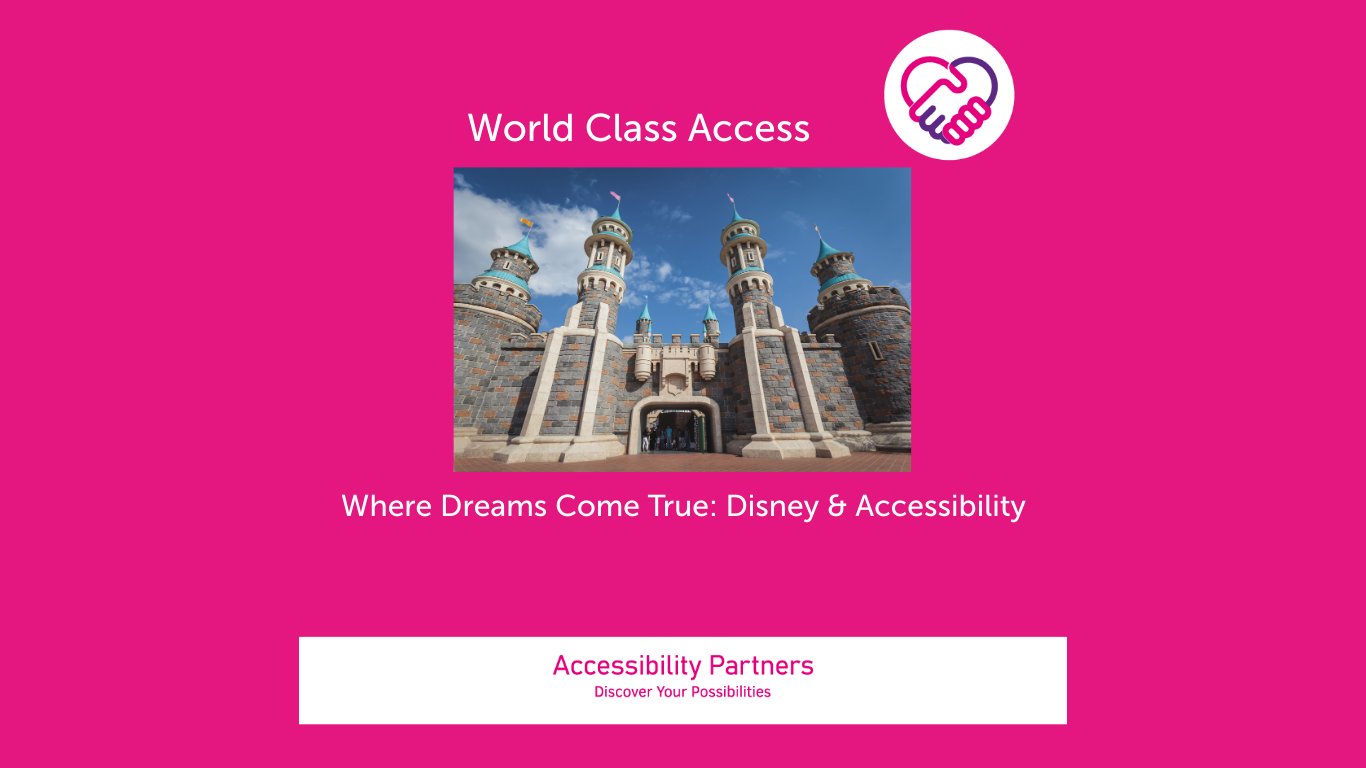
On a hot pink background in white font is the title: World Class Access, accompanied by the Accessibility Partners logo on the right (two clasped hands, one pink and the other purple forming a heart shape. Underneath the title is an image of a castle, evocative of the iconic Disney castle! It has stone-brick textures with multiple towers and turrets, each turret is topped with colourful flags. The castle’s centrepiece is a large arched entrance, inviting viewers in. Underneath that image, also in white font are the words: Where Dreams Come True: Disney & Accessibility The bottom of the image features a white banner with pink text inside that reads: “Accessibility Partners Discover Your Possibilities”

This week’s World Class Access sees us focusing on the Disney empire! A global mass media and entertainment conglomerate, Disney currently operates twelve theme parks located across six resort campuses in four countries, including the USA, France, and China. Last year, the revenue generated from the parks alone was nearly $34.2 billion.

Guests with disabilities are welcome at the park, and they have a wealth of facilities available to ensure your visit is as magical as possible, whatever your needs.

For guests with mobility issues, designated load and unload zones are available for attractions, as well as wheelchair-accessible ride vehicles. Measures are in place to ensure queuing is as comfortable as possible, including provisions for accessing shorter queues where possible. Neurodivergent guests have access to designated “take break areas” that are quieter should they need to decompress, as well as sensory guidance for the experiences at the parks, including scents, lighting effects and attraction speeds.

Assistive technology like sign language interpretation, assistive listening, handheld captioning, audio description, portable tactile maps and stationary braille maps for those with low vision and hearing loss. 

Many of the available facilities can also benefit those without specific disabilities, underscoring the enduring value of inclusive design.

Planning and navigating a trip to a new destination with accessibility needs can feel overwhelming; Disney’s frontline “Cast Members” are trained to support all their guests, with a particular specialisation in neurodiversity. To ensure your visit is the best it can be, our staff can assist you in booking the right hotels and selecting suitable experiences so you know what to expect when planning your holiday. 

What would make World Class Access for you? 

Have you seen something or somewhere that you think is an excellent example of inclusion or accessibility?

Categories
News

World Class Access: Expo City, Dubai

Inclusion by design…

On a hot pink background in white font is the title: World Class Access, accompanied by the Accessibility Partners logo on the right (two clasped hands, one pink and the other purple forming a heart shape. Underneath the title is an image of a sweeping view of Expo City in Dubai, dominated by a circular architectural structure. The intricate lattice-like design forms a dramatic canopy overhead, casting patterned shadows across the open plaza below. Palm trees line the space, where people casually stroll or gather.

This week in World Class Access, we’re featuring Expo City in Dubai, capital of the United Arab Emirates. Dubai has a universal design code whereby the built environment and transportation systems in the city are designed, constructed and managed to ensure equal access for all, including People of Determination – the term used within the country to describe those with disabilities. 

Nowhere is the strength and value of universal design more apparent than in Expo City, a fully accessible public realm built from the ground up, featuring homes, businesses, event venues, amenities, green spaces, and smart transportation options. Features include ramps, tactile guide paths, clear and Braille signage, hearing induction loops,  sensory rating cards, wheelchair-accessible buggies, and power wheelchair charging stations.

The city is at the forefront of Dubai’s plan for future growth and sustainability, as they envision becoming a model for urban excellence, encouraging healthy living by design, and aim to be a driving force of growing business, building on the legacy of “Expo 2020 Dubai”, where new accessibility benchmarks were set.

What would make World Class Access for you? 

Have you seen something or somewhere that you think is an excellent example of inclusion or accessibility?

Categories
News

World Class Access: The British Library

|On a hot pink background in white font is the title: World Class Access, accompanied by the Accessibility Partners logo on the right (two clasped hands, one pink and the other purple forming a heart shape. Underneath the title is an image of: The British Library, based in London.Underneath that image, also in white font are the words: Read All About It: Accessibility at The British Library. The bottom of the image features a white banner with pink text inside that reads: “Accessibility Partners Discover Your Possibilities”.

We all love to relax with a good book… 

In this week’s World Class Access, we’re focusing on The British Library. Based in London, the British Library is the national library of the UK, housing a collection of over 170 million items from all over the world, including books, newspapers, maps, stamps, patents and even sound recordings.

With spaces to read, meet friends, and find support in starting and running your business, as well as a wealth of galleries and exhibits to inspire, accessibility is paramount.

All floors have step-free access, including event spaces, Reading Rooms, exhibitions and learning centres. Doors to the Reading Rooms and Knowledge Centre operate with button-assisted opening, and the Reading Rooms offer a range of assistive technologies, including height-adjustable tables, lower service desks, alternative keyboards, and other equipment for individuals with visual or hearing impairments.

Hearing induction loops are available at numerous points, and guide and assistance dogs are welcome. Concessions are available for disabled visitors to ticketed events, as well as a free ticket for personal assistants that can be booked in advance.

The library has a second site in Yorkshire, and in March of this year, unveiled plans for a  1.1 billion renovation project, aiming to expand the library’s public spaces as well as the commercial and retail areas.

What would make World Class Access for you? 

Have you seen something or somewhere that you think is an excellent example of inclusion or accessibility?  Let us know in the comments, and we’ll do our best to feature it.
Categories
News

World Class Access: The National Gallery, Singapore

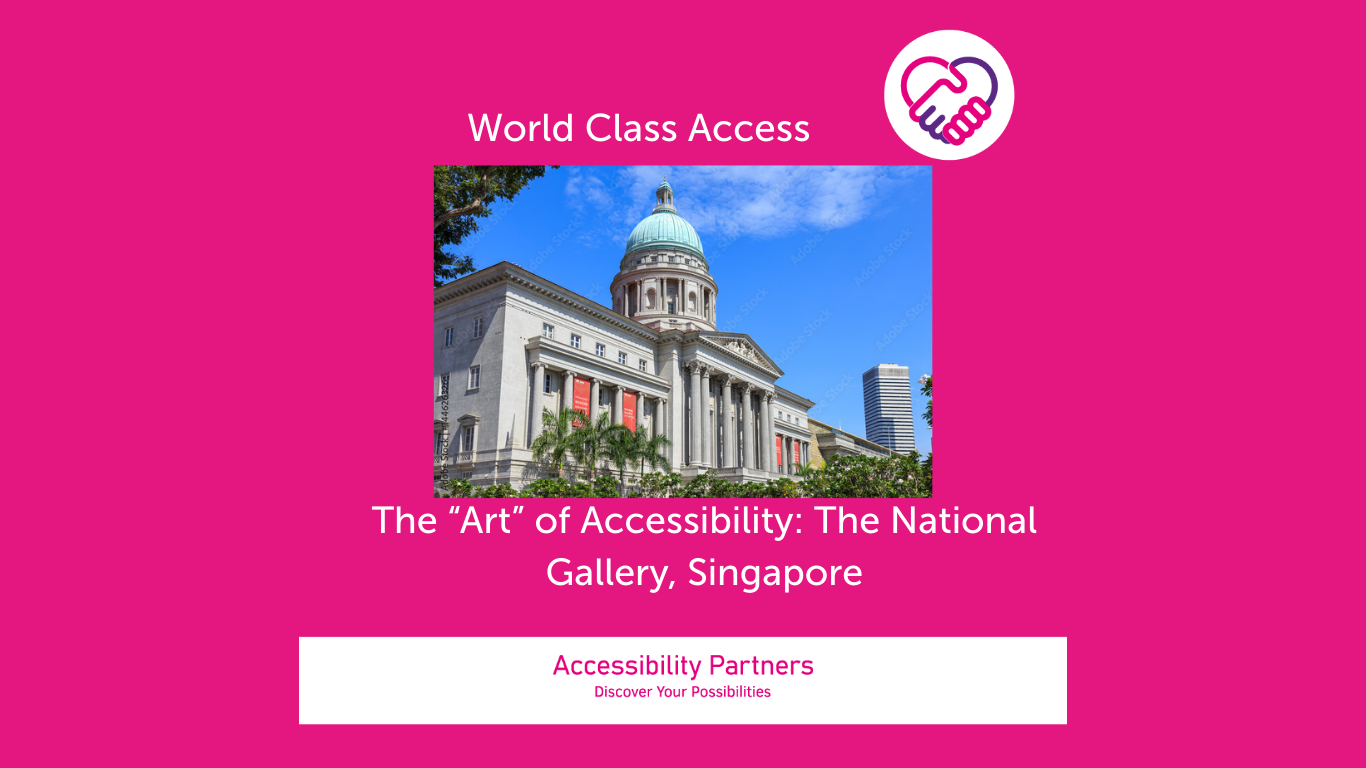
On a hot pink background in white font is the title: World Class Access, accompanied by the Accessibility Partners logo on the right (two clasped hands, one pink and the other purple forming a heart shape. Underneath the title is an image of The National Gallery, Singapore. Underneath that image, also in white font are the words: The "Art" of Accessibility: The National Gallery, Singapore, and at the bottom of the  image a white banner with the words: "Accessibility Partners Discover Your Possibilities" inside in pink font.

Anyone for art? 

For this week’s #World Class Access, we’re celebrating the National Gallery in Singapore. The Gallery oversees the most extensive public collection of Singaporean and regional art in the Eastern world, with over 9,000 pieces.  As a result, it’s widely considered one of the most visited art museums in the world, with over two million annual visitors!

They’ve got accessibility down to a fine art here, with facilities that include:

  • Calm Rooms: Specifically designed for guests who feel overwhelmed or overstimulated by the environment and want to decompress.
  • Comprehensive staff training for a variety of access needs, including dementia
  • Access Guides with floor plans, directions and information on key policies and features in the gallery.

All exhibition spaces and floors are wheelchair accessible. Their “HOLD” (Hands-On Learning & Development) Collection is curated as a series of tactile, multi-sensory adaptations of artworks, encouraging inclusive learning through touch, sound and interaction.

The Gallery strives to provide an understanding of and appreciation for Singapore’s heritage and culture through various mediums, as well as its relationship with other Asian and global cultures. The building comprises the former Supreme Court and City Hall buildings, as well as two national monuments, resulting in a combined floor area of 690,000 square feet.

What would make World Class Access for you? 

Have you seen something or somewhere that you think is an excellent example of inclusion or accessibility? 
Let us know in the comments, and we’ll do our best to feature it.

Categories
News

World Class Access: Sela Sound Shirts

The new football season has kicked off. 

Next in World Class Access, we celebrate a novel way to feel and experience “The Beautiful Game”!

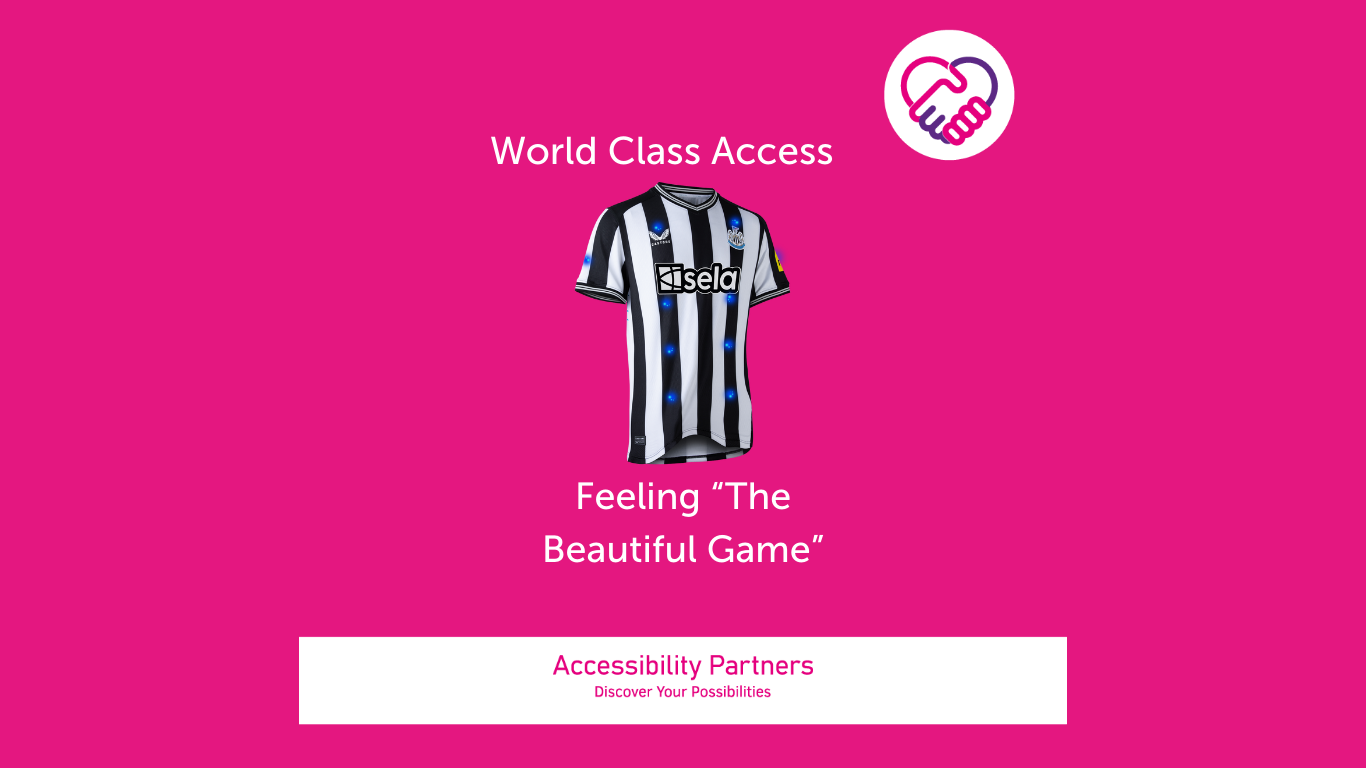
On a hot pink background in white font is the title: World Class Access, accompanied by the Accessibility Partners logo on the right (two clasped hands, one pink and the other purple forming a heart shape. Underneath the title is an image of a Newcastle United Home Football Shirt marked with blue lights at various points on the chest and sleeves, indicating placement of technology. Underneath that image, also in white font are the words: Feeling "The Beautiful Game".The bottom of the image features a white banner with pink text inside that reads: “Accessibility Partners Discover Your Possibilities"

Research from the charity Level Playing Field in 2024 says that 33% of fans cite physical access to venues and stadiums as their most significant barrier to attending live sports events. Many clubs are making positive strides towards better inclusion, one such being Newcastle United and their principal partner, Sela.

As part of their 2024 “Unsilence the Crowd” campaign, Sela debuted new shirts for the club, featuring innovative technology designed to make match day more inclusive for deaf or hard-of-hearing fans. The Sela Sound shirts are made from conductive textiles and fitted with haptic technology.

Haptic technology works by converting sounds from the pitch via specialist software into touch data, which is then transmitted wirelessly to the shirt, allowing fans to feel all the elements of a live game. The technology debuted during Newcastle’s game with Tottenham Hotspur, which saw the home team win 4 – 0.

The club has committed to making the shirts a permanent fixture at St James’ Park as part of their expanding accessibility provision.

Away from the football pitch, haptic technology is helping to make other industries more inclusive, including aviation and space exploration, as well as everyday use, such as smartphones and gaming. Although the shirts by Sela are marketed explicitly toward and for deaf fans, haptic technology can also benefit those with visual impairments, as it can be used to substitute for both visual and audio data. As technology continues to develop and grow, so too can the many ways it enriches and supports inclusivity.

What would make World Class Access for you? 

Have you seen something or somewhere that you think is an excellent example of inclusion or accessibility? 

Categories
News

World Class Access – Beaches For All: Nice, France

Getting ready for your beach holiday?

On a hot pink background in white font is the title: World Class Access, accompanied by the Accessibility Partners logo on the right (two clasped hands, one pink and the other purple forming a heart shape. Underneath the title is an image of a pebbled beach in Nice, France. There is a path leading to an area of the beach with amphibious wheelchairs and shaded areas either side to sit under. The path is marked with a wheelchair symbol and stripes, both in blue and white. Under the image, it reads: Barrier Free Beach Days: Nice, France
The bottom of the image features a white banner with pink text inside that reads: “Accessibility Partners Discover Your Possibilities"

Next in World Class Access, we celebrated two “Beaches for All” in Nice, South of France. Both Plage de Carras & Plage de Centenaire have a multitude of facilities to help make the beach more accessible and inclusive, including:

  • Ramps and non-slip Mobi mats for a smoother journey along the pebbly terrain and to the shoreline.
  • Amphibious wheelchairs, which stay stable in the water (with dedicated, fully trained staff on hand should you need support).
  • Audio systems on buoys and wristbands so that visually impaired swimmers can stay safe and secure

All of these facilities are available for free, without the need to book and without justification (dispensing with the idea that you need to “prove” to anyone why they are needed).

Did you know that Nice is visited by approximately 5 million tourists a year, and is France’s second most popular destination after Paris?  Facilities like those available at their “Beaches for All” are a great example of how accessible design can benefit everyone, irrespective of their access needs, as they were designed with a broader view of varying circumstances in mind.

What would make #WorldClassAccess for you? 

Have you seen something or somewhere that you think is an excellent example of inclusion or accessibility?